
Did you know? That elegant reed diffuser on your shelf is performing a complex scientific ballet 24/7. Unlike candles or plug-ins, reed diffusers use pure physics to scent your space – no heat, no electricity, just clever liquid dynamics.
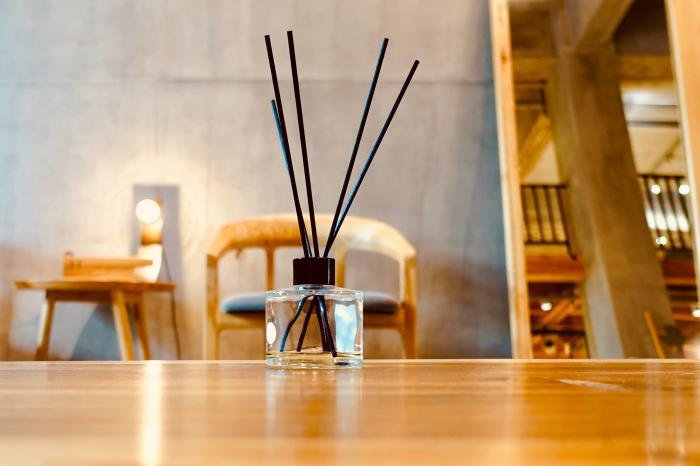
The Magic of Capillary Action
At the heart of every reed diffuser lies a simple but powerful phenomenon called capillary action. This is the same principle that allows trees to draw water from their roots to their highest leaves. In your diffuser, specially designed reeds act like microscopic elevators for scented oil.
When you first insert dry reeds into the oil, millions of tiny channels in the reed material immediately begin absorbing the liquid. These channels, called lumen, are so narrow that the liquid actually climbs upward against gravity through surface tension alone. The thinner your fragrance oil, the faster this wicking occurs – though too thin and it will evaporate too quickly.
What’s fascinating is that this process never stops. As fragrance molecules evaporate from the exposed reed tops, new liquid continually rises to replace it. This creates a self-sustaining cycle that continues until either the oil runs out or the reeds become completely saturated (which is why flipping them periodically boosts performance).
Why Reed Material Matters
Not all reeds are created equal. The most effective diffuser reeds are made from natural rattan – a porous tropical vine that’s been used for centuries in basketry. Under a microscope, rattan looks like a bundle of tiny straws, perfect for capillary action.
Plastic or synthetic reeds might look similar, they lack the complex internal structure needed for proper wicking. Some premium diffusers use bamboo reeds, which work well but tend to be slightly less effective than rattan. The diameter matters too – thinner reeds (3-4mm) work better for lighter fragrances, while thicker ones (5-6mm) handle denser oils more efficiently.
Interestingly, the reeds aren’t just passive transporters – they actually help filter and modulate the fragrance release. As oil travels upward, some scent compounds interact with the reed material itself, creating subtle changes in how the fragrance develops in your space compared to if it were sprayed directly.
The Oil’s Crucial Role
The fragrance oil blend is the other half of this scientific equation. Unlike candle wax or electric diffuser liquids, reed diffuser oils must achieve a perfect balance:
- Viscosity: Thin enough to climb reeds, but thick enough not to evaporate instantly
- Volatility: Contains both fast-evaporating top notes and lingering base notes
- Stability: Won’t separate or degrade over months of exposure to air
Most quality diffuser oils use a combination of dipropylene glycol (DPG) or isopropyl myristate as carrier solvents. These colorless, odorless liquids help regulate the fragrance release while preventing reed clogging. The fragrance concentration is typically higher than in sprays – often 15-25% compared to 8-15% in fine perfumes.
Proper oil maintenance makes a huge difference too. Dust that accumulates on the oil’s surface can actually create a barrier that slows evaporation. Giving the bottle a gentle swirl every few weeks redistributes the fragrance compounds and maintains consistent scent throw.

Environmental Impacts You Never Noticed
Your reed diffuser is in constant conversation with its environment. Unlike electric diffusers that deliver consistent output, reed diffusers naturally adapt to their surroundings:
- Temperature: Every 10°F increase roughly doubles evaporation rate
- Humidity: Dry air pulls fragrance molecules more aggressively
- Airflow: Diffusers near vents work harder but exhaust faster
- Sunlight: UV rays can break down delicate fragrance compounds
This explains why the same diffuser might perform differently in your bedroom versus bathroom, or seem stronger in winter than summer. The positioning height matters too – since scent molecules tend to sink, placing diffusers at nose level (rather than high shelves) maximizes their perceived strength.
The Hidden Life Cycle
Those beautifully simple glass bottles conceal surprisingly complex activity over their lifespan:
Phase 1 (Days 1-7): Initial saturation where reeds "learn" your oil’s properties
Phase 2 (Weeks 2-8): Peak performance with balanced scent delivery
Phase 3 (Months 3-4): Gradual decline as reeds clog and oil oxidizes
Savvy users extend Phase 2 by rotating reeds weekly (flip end-for-end) and topping up oil when halfway depleted. Contrary to popular belief, adding more reeds doesn’t always increase scent – beyond 8-10 reeds, they begin competing for the same oil reservoir.
Why This Outperforms Other Methods
Compared to other home fragrance systems, reed diffusers offer unique advantages rooted in their passive design:
- No heat means no scent alteration (candles burn fragrance notes unevenly)
- Consistent delivery (unlike sprays that pulse between strong and weak)
- Gentler on scent-sensitive people (no forced-air projection)
- Lower maintenance (no wick trimming or bulb replacement)
The reed’s slow capillary action acts as a natural "time-release" system for fragrance, which is why well-designed diffusers can maintain the same character for months rather than shifting dramatically like candles often do.




 English
  Spanish
  Portuguese
  French
  Russian
  Polish
  Czech
Czech