
In our quality lab, a single reed diffuser stick undergoes a capillary absorption test, its progress measured in millimeters per hour against a gold-standard control; this minute data point is the first domino in a chain that ensures a consistent fragrance experience in a customer’s home three continents away.
Contents hide
For a luxury diffuser manufacturer, optimal scent diffusion is not a happy accident—it is the inevitable outcome of a closed-loop control system. We treat the reed and the oil not as separate components, but as a single, symbiotic delivery system. Controlling this system from source to shelf requires a mastery of material science, fluid dynamics, and rigorous sensory validation.

01 The Anatomy of a Reed: Sourcing and Engineering the Capillary Conduit
The reed is the engine of diffusion, and its quality begins at the botanical source. We exclusively use the porous stems of Borassus flabellifer (Palmyra palm) or sustainable Verbena bundles, selected for their straight, consistent grain and inherent capillary structure.
Each incoming batch is subjected to a Three-Point Material Audit: Pore Density (measured via micro-CT scanning to ensure optimal void space), Lignin Content (which can inhibit oil travel if too high), and Moisture Equilibrium (strictly controlled at 8-12%). Reeds are then precision-cut and calibrated through a proprietary thermal-etching process. This mild, controlled carbonization of the inner channels standardizes surface tension and wicking speed, transforming a natural product into a predictable, performance-grade component before it ever touches oil.
02 The Chemistry of the Carrier: Formulating for Controlled Release
The fragrance oil is not merely a scented liquid; it is a finely tuned vehicle. Our focus begins with the carrier oil ratio, a proprietary blend of diethyl phthalate (DEP), isopropyl myristate (IPM), and specialty alcohols.
We engineer this base for specific kinematic viscosity (typically 7-9 cSt at 20°C) to match the calibrated uptake rate of our reeds. The ratio is adjusted seasonally and by fragrance family: a light citrus oil may require a thinner, faster-traveling base (higher alcohol content), while a dense oriental blend needs a slightly more viscous base (higher IPM ratio) to prevent rapid top-note burnout and ensure balanced scent diffusion over time. This carrier system is the unsung hero that determines whether a fragrance "throws" properly or fades prematurely.
03 The Source Lock: Dual-Traceability for Raw Materials
Consistency is impossible without traceability. We implement a Dual-Traceability Protocol for both core materials.
For reeds, this means Single-Origin Sourcing from partnered plantations, with harvest dates and lot numbers tracked. For fragrance oils, we go beyond GC-MS reports. We work with select fragrance houses to establish "Locked Formulations," where every aromatic raw material is sourced from a pre-audited supplier. We maintain a Physical & Digital Reference Library containing samples and chromatograms of every approved raw material and master batch. Any new shipment must pass a Triangle Test against its library reference in our lab before being cleared for production, ensuring an unbroken chain of sensory and chemical fidelity back to the source.
04 The Binding Process: Precision Saturation and Conditioning
The moment the reed meets the oil is critical. We employ a Two-Stage Saturation Protocol that moves far beyond simple soaking.
First, reeds undergo Ultrasonic Degassing in a mild solvent to remove micro-air pockets from their capillary channels. They are then transferred to a Vacuum-Pressure Impregnation Chamber. Here, oil is introduced under a controlled vacuum, which is then released to allow atmospheric pressure to forcibly drive the oil deep into the reed’s core structure. This ensures complete, uniform saturation from the first moment of use. Following impregnation, saturated reeds enter a Conditioning Phase in a climate-controlled environment for 72 hours, allowing the oil to reach a perfect molecular equilibrium throughout the fiber, preventing initial "gushing" or uneven diffusion.
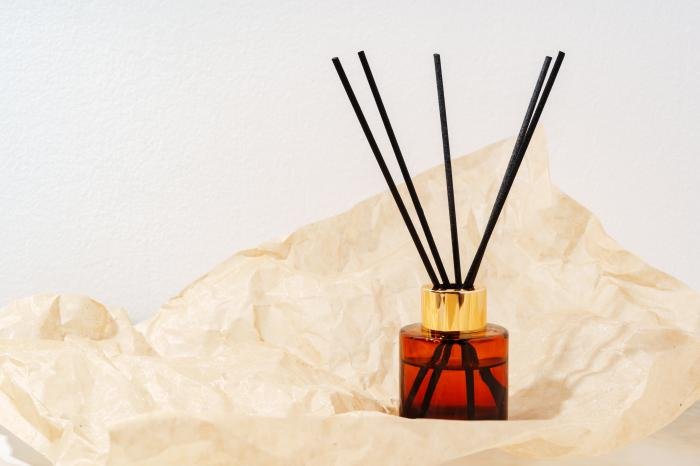
05 The Performance Validation: Quantifying Diffusion in Real-Time
Every matched pair of reeds and oil must prove its performance in our Diffusion Validation Suite.
We use Standardized Environmental Chambers that precisely control temperature (22°C), humidity (50% RH), and air exchange rates. Inside, diffusers are activated, and their output is measured not just by human panels, but by Real-Time Analytical Instruments. A Photoionization Detector (PID) quantifies total volatile organic compound (TVOC) emission curves over 14 days, while Solid-Phase Microextraction (SPME) fibers paired with GC-MS allow us to snapshot the precise ratio of top, middle, and base notes in the air at any given time. This data generates a Diffusion Performance Profile, which must fall within a strict sigma range of our established gold standard for the fragrance.
06 The Closed Loop: From Stability Testing to Consumer Guidance
Our control extends to predicting and ensuring performance over the product’s entire lifecycle.
Finished products undergo ICH-Q1 Accelerated Stability Testing, stored at 40°C for three months to simulate a year on the shelf. We monitor for oil separation, reed discoloration, or any alteration in the diffusion profile. Finally, we close the loop with Evidence-Based Consumer Guidance. Our instructions ("Use 6 reeds for a room of 30m³," "Flip reeds every 5-7 days") are not generic advice but data-driven directives derived from our validation tests. This ensures the end-user activates the system exactly as engineered, completing the final, critical step of quality control we began at the source.
Mastering diffusion is the art of eliminating variables. From the density of a plant’s stem to the precise flip of a reed in a vase, our process is a relentless pursuit of predictability, ensuring the scent experience we design is the one that faithfully arrives in your home.




 English
  Spanish
  Portuguese
  French
  Russian
  Polish
  Czech
Czech