
In the competitive home fragrance landscape, a reed diffuser is more than just a bottle of scented oil; it is an ambient experience. For brands, success isn’t just about a pleasant smell—it’s about engineering a product that performs reliably in varied environments.
As industry professionals, we don’t just guess what works; we analyze the data. By systematically reviewing feedback from major e-commerce platforms and social media, we have identified the Gold Standard for high-performing diffusers.
Below, we break down the critical factors that drive 5-star reviews and the common pitfalls that lead to consumer complaints.

Part 1: The "Big Three" Drivers of Satisfaction
When consumers rate a reed diffuser, their judgment almost always falls into three measurable dimensions. Understanding these allows us to engineer better products from the start.
1. Scent Performance: Radius & Fidelity
This is the deal-breaker. A "good" scent isn’t enough; it must perform.
- The "Throw" (Diffusion Radius): Consumers want a scent that fills the room, not just the corner. Top-rated products are praised for their ability to cover 10-20 square meters effectively without becoming overpowering.
- True-to-Life Accuracy: If a label says "Fresh Cut Grass," the user expects exactly that. High fidelity between the marketing description e o olfactory reality is crucial for building trust.
- Scent Stability: The fragrance character should remain linear. It shouldn’t turn sour or chemical-smelling as the oil oxidizes over time.
2. Longevity & Evaporation Rate
Longevity is the consumer’s proxy for "Value for Money."
- The "Goldilocks" Rate: The liquid shouldn’t evaporate in two weeks (too fast = waste), nor should it sit stagnant for six months with no scent (too slow = clogged reeds). A balanced solvent system is key here.
- Consistency: A common complaint is "strong for 3 days, then nothing." Superior formulations maintain a steady evaporation curve from the first drop to the last.
3. Aesthetics & Mechanics
A diffuser is semi-permanent home decor.
- Vessel Stability & Design: Heavy-bottomed glass is preferred for stability. Consumers also look for designs that blend into various interior styles (minimalist, modern, rustic).
- Qualidade da cana: This is often overlooked. Engineered fiber reeds generally outperform natural rattan in terms of anti-clogging and color consistency, leading to better reviews.
Part 2: Common Pitfalls (Voice of the Customer)
Negative reviews are a goldmine for product improvement. Here are the top complaints we see in the market:
- "I can’t smell it unless I’m standing over it."
- Cause: Poor solvent volatility or low fragrance concentration.
- Fix: Optimization of the carrier oil and increasing the fragrance load.
- "It smelled great but was gone in 2 weeks."
- Cause: Alcohol-based solvents evaporating too quickly in warm environments.
- Fix: Switching to slower-evaporating, eco-friendly solvents (like certain glycol ethers or bio-based carriers).
- "The scent smells ‘fake’ or ‘chemical’."
- Cause: Low-quality raw materials.
- Fix: Investing in higher-grade essential oils and aroma compounds.
- "The reeds turned dusty and stopped working."
- Cause: Dust accumulation on oil-saturated natural rattan.
- Fix: Educating users on flipping reeds or using high-performance fiber sticks.
Part 3: Innovation Opportunities for Your Brand
Based on this feedback, here are three strategic directions for your next product line:
1. Customizable Intensity (The "Control" Factor)
Consumers want control. Marketing your product with adjustable solutions—such as including varying numbers of reeds or different reed thicknesses—empowers the user.
- Idea: Sell a "Starter Kit" with 8 reeds but advise using 4 for small rooms and 8 for large living spaces.
2. Functional & Scenario-Based Positioning
Move beyond "smelling good" to "doing good." The market is hungry for functional fragrances.
- Sleep Aid: Lavender & Chamomile blends for the bedroom.
- Focus Booster: Rosemary & Lemon for the home office.
- Odor Eliminator: Specialized molecules for kitchens or bathrooms.
3. Transparency & Education
Many negative reviews stem from user error. Brands that educate win loyalty.
- On-Pack Tips: Clearly print instructions: "Flip reeds weekly for best results" or "Place in high-airflow areas."
- Refill Systems: Launching stylish, reusable vessels alongside economical refill pouches aligns with sustainability trends and encourages repeat purchases.
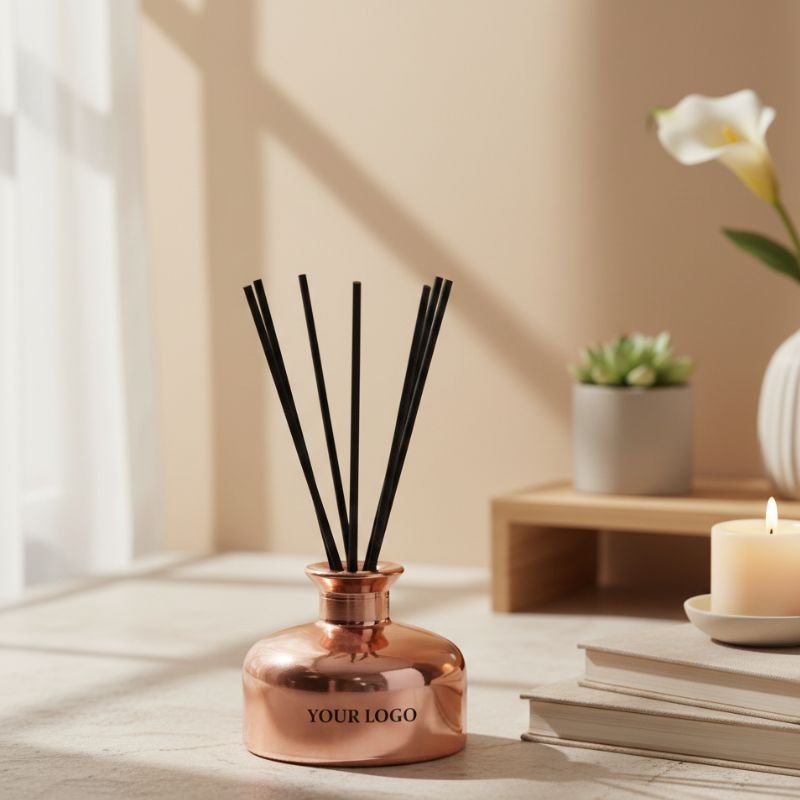
Conclusion: Engineering Success
A successful reed diffuser is built on a foundation of chemistry and consumer psychology. It requires balancing the art of perfumery with the science of evaporation.
For brand owners, the takeaway is clear:
- Prioritize the formulation: Don’t cut corners on the solvent system.
- Align expectations: Be accurate in your scent descriptions.
- Solve the pain points: Address longevity and throw issues before the product hits the shelf.
Ready to develop a 5-star difusor de palhetas?
At our manufacturing facility, we use data-driven insights to formulate products that perform. From selecting the perfect reed fiber to testing evaporation rates, we help you build a product that consumers love. Contact us today to start your project.




 Portuguese
  English
  Spanish
  French
  Russian
  Polish
  Czech
Czech